Manfred Nowak and Manu Krishan — Secretary General and Head of Global Study Programme, Global Campus of Human Rights
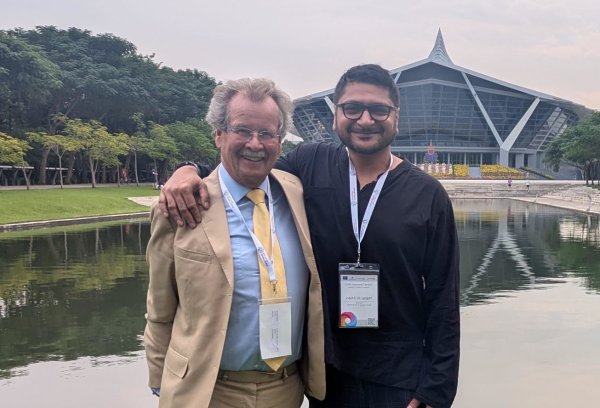
Manfred Nowak is Secretary General of the Global Campus of Human Rights — a network of roughly 100 member universities, the largest of its kind dedicated to human rights — and served as UN Independent Expert leading the UN Global Study on Children Deprived of Liberty, following earlier roles as UN Special Rapporteur on Torture and Professor of International Law and Human Rights at Vienna University.
Manu Krishan coordinates the Global Campus's Global Study Programme, leading the Global Study's follow-up work alongside Manfred Nowak, and serves on the Steering Committee of the World Congress on Justice with Children and Child Friendly Justice European Network.
What would you say have been the main impacts or consequences of the Global Study on Children Deprived of Liberty since its publication in 2019?
We still know very little, because one of the Study's key recommendations — continued, improved data collection — was never followed up on. In December 2019, the General Assembly merely "took note" of the Study, without setting up any follow-up mechanism, and COVID-19 blocked its first years of implementation. No UN resolution has ever operationalised that recommendation, so we still can't say with confidence what has changed for the 7.2 million children the Study estimated were deprived of liberty every year: 5.4 million in institutions, 1.4 million in the administration of justice, 330,000 in immigration detention, 35,000 in armed conflict, 1,500 on national security grounds, and 19,000 with a primary caregiver; and the poorest, most marginalised children face far higher odds of ending up behind bars than children from wealthier families. In some respects, the world has become harder for these children since 2019. Several governments have moved to lower, not raise, the minimum age of criminal responsibility: Argentina by law, Sweden and the Philippines by ongoing proposal, to name just a few.
The Global Campus network helped prepare the Study itself: the University of Pretoria led its chapter on institutions, and our own Venice-based team drafted the chapter on children living with their primary caregivers in prison. When the UN's own budget fell short, it was two private foundations that ultimately gave more than all Member States and international organisations combined, in order to keep it financially viable, while the actual work of finishing, editing and disseminating it fell to the Global Campus, its network and the Ludwig Boltzmann Institute of Human Rights in Vienna.
A long-term partnership with the Right Livelihood Foundation has funded our continued follow-up work since: practical toolkits, a child-friendly animated film, a series of MOOCs, and our flagship annual Global Classroom, feeding into the peer-reviewed Global Campus Human Rights Journal, where students and regional child rights officers and professors worked together on regional global study Follow-up academic papers.
On the ground and in regard to implementation, its impact has shaped initiatives such as the deinstitutionalisation work in the Caucasus, an oversight mechanism for children in South Africa's Secure Care Centres, policy research in South Asia, and a national review in Austria and other countries, among the first implementation projects. We have presented the Global Study in all regions and within 55 international and national events, as well as implemented over 30 projects since 2019. Its normative foundation is close to universal, as the Convention on the Rights of the Child has been ratified by 196 states — more than any other human rights treaty, and by every UN member except the United States.
When it comes to thematic areas, immigration detention is the clearest case of change: the Study concluded that no circumstances justify detaining a child for migration reasons, and by its own count 24 countries, most of them in Latin America and Southern Africa, have already stopped doing so entirely.
Institutions detention shows a similar trend, as the number of children in institutional care appears to have fallen from around 8 million estimated by the 2006 Pinheiro Study on Violence against Children to roughly 5.4 million by the time of the Global Study in 2019 — independently corroborated by a 2020 peer-reviewed study that put the global figure at a very similar 5.37 million.
In the administration of justice, the number of children in pretrial detention and prisons appears to have fallen by more than half since UNICEF's 2007 estimate of over a million, as more States have adopted specialised child justice systems and diversion. The Study was also drafted in parallel with the CRC Committee's own General Comment No. 24 (2019) on children's rights in the child justice system, adopted just two months before the Study's launch, and that momentum continues into the Committee's forthcoming General Comment No. 27 on children's access to justice and effective remedies, now in its final rounds of consultation.
In armed conflict, the trend has also moved toward diversion rather than incarceration: since 2013, Chad, Mali, Niger and Somalia have each signed handover protocols transferring children suspected of association with armed groups to civilian child-protection actors, a practice the Security Council formally endorsed in Resolution 2427 (2018). Even so, conflict remains the starkest exception to this progress: children in Israeli military courts and administrative detention in the West Bank were already flagged in the Global Study, and the numbers held there have only grown since, reaching record levels by the end of 2025, while the UN's own 2025 monitoring recorded the highest number of grave violations against children in conflict since records began, driven above all by Gaza and the West Bank, Sudan, Myanmar, the DRC and Nigeria.
Despite this progress, children deprived of liberty and children's rights more broadly often struggle to remain a permanent, top-level priority on national agendas. What do you see as the main obstacles still standing in the way?
The Global Study's own framing captures this best and states that children deprived of liberty are invisible to the large majority of society, and their situation is probably the most overlooked violation of the Convention on the Rights of the Child. They are, quite literally, behind walls, i.e. in police cells, closed institutions, migration detention, so there is no natural public constituency pushing their situation onto a government's agenda.
It doesn't help that this is nobody's single responsibility. Children deprived of liberty sit across justice, migration, health, education and social welfare systems at once, so no one ministry owns the problem, and it is easy for all of them to treat it as someone else's priority. Add to that the stigma attached to children in conflict with the law, which makes them a politically unrewarding group to support, and underfunding, even the Global Study itself only proceeded on roughly 15% of its planned budget, and had to be rescued by voluntary contributions from a handful of States, the EU and two private foundations. If the flagship research effort struggled for resources, it says something about where this issue really sits on the list of priorities.
One of the significant findings of the Global Study was the widespread failure of States to ensure continuity of education for children deprived of liberty. What would you say are the main obstacles to guaranteeing that these children retain access to their fundamental right to education?
The Study's guiding principle here is that deprivation of liberty does not mean deprivation of liberties. This means that children who lose their right to personal liberty are entitled to keep every other right, including education, and States are obliged to make that possible in detention.
In practice, this is one of the areas where the gap between principle and reality is widest. Access to some form of schooling or vocational training in detention is fairly common, but it is inconsistent, often informal, and rarely continuous. Children told us that certificates earned in detention sometimes omit any mention of the institution, out of concern that a correctional record would follow and stigmatise them later, which speaks to how little confidence there is that this education is treated as equivalent to schooling outside. And once released, many children, especially those detained for extended or unpredictable periods, or in conflict and migration settings simply cannot pick education back up i.e schools have moved on, records are incomplete, and the systems that should coordinate a handover between detention, education and social services rarely do.
Partners like Baker McKenzie, a longtime pro bono supporter of the World Congress on Justice with Children, run experiential exercises such as In My Shoes to help legal and advocacy professionals understand these everyday obstacles and systemic issues — including the issue of education —- from a young person's perspective, which is exactly the kind of empathy-building this issue needs more of.
Promoting the active participation of children is one of the essential elements for achieving child-friendly justice systems. Could you provide examples of justice systems where child participation has been integrated most effectively?
Let's say it plainly: Article 37(b) of the Convention states that a child may be deprived of liberty only "as a measure of last resort and for the shortest appropriate period of time." Both of those judgements are impossible to make responsibly without the child's own participation, only the child can tell you whether a non-custodial alternative would actually work for them, or when it is genuinely safe to release them. That holds whether the system frames the child as a victim, as in migration or primary-caregiver settings, or as a perpetrator, as in the administration of justice. The starting point has to be that children are consulted, informed and actively engaged in improving the very systems meant to serve them, not simply spoken for.
The Global Study itself set that example by interviewing 274 children with lived experience of deprivation of liberty directly, and that practice needs to continue rather than end with the Study. The Convention's four guiding principles, that of non-discrimination, the best interests of the child, the right to life, survival and development, and participation, read together with Article 37(b), make clear that what happens to children simply cannot be determined without their participation. In practice, though, participation is barricaded not only by the physical reality of detention centres, but often by ethical review processes that States may use to shield themselves from scrutiny rather than to protect children.
We have experienced this first-hand, i.e., we were once stopped from interviewing children after they disclosed systematic abuse within an institution, with the need for "ethical clearance" cited as the reason. Too often, that clearance functions less to protect children than to protect the institutions responsible for them.
One example we're proud of is the Child Leadership Team at the Global Campus, led by the children’s rights department, now also replicated regionally, a European Child Leadership Team was set up in 2024/2025. These are not one-off consultations and children with lived experience sit with us as we plan our work, and we have opened doors for them well beyond our own institution. Between October and December 2025, 35 Child Leadership Team and Youth Advisory Group members from six regions took part in research and consultations feeding directly into the Global Commission on Drug Policy's work on how drug policies affect children's rights.
Looking ahead, what would you consider the priority actions for governments, UN agencies and civil society to build on the Global Study's legacy and truly advance the protection of children deprived of liberty?
The first priority is to continue what the UN general assembly itself never operationalised: continuous, coordinated data collection on children deprived of liberty. Without it, we are simply guessing at whether anything has improved since 2019.
The building blocks are already there, The Global study itself, the 2025 Declaration on Advancing Child-Centred Justice and the NGO Panel's Roadmap for Action on Children Deprived of Liberty (2025–2030) are there to be implemented. What's missing is the resourcing and political weight to move them from declarations to results. This has been a coordinated, concerted effort and it deserves to be treated as one rather than as a set of parallel initiatives.
Further areas deserve dedicated attention going forward. One is measurement i.e. anchoring this agenda explicitly in SDG target 16.2, the global commitment to end violence against children, would give it a ready-made benchmark the Study's own follow-up never had. The other is a form of deprivation of liberty the Study did not anticipate: children and young people detained for taking part in protests, a pattern spanning every region. Children as young as nine were arrested during protests in the Philippines, detained children were beaten and denied access to lawyers in Bahrain, minors were charged following protests in Morocco, and UNICEF called for the release of children detained during Iran's protests. Further afield, documented arbitrary arrests of children, alongside three child deaths, during Nepal's 2025 Gen-Z protests, and seven juveniles were apprehended amid unrest in Manipur, India. Climate protests are no exception either and since 2024, young Fridays for Future activists opposing the East African Crude Oil Pipeline in Uganda have been repeatedly arrested in Kampala, part of a wider crackdown on climate defenders. This deserves further attention as the settings the Study already covers.
The Global Study will mark its tenth anniversary in 2029. Looking toward that milestone, would a follow-up study be timely and feasible — one that takes stock of the progress achieved the gaps that persist, and the new challenges that have emerged since 2019?
Yes! And we would go further and say it is necessary, not just timely. Ten years on, we still do not know, with any rigour, what has actually changed for these children. A follow-up study would let us take honest stock, i.e., of the progress made, of the data we still lack, and of new and worsening forms of deprivation of liberty that have emerged since 2019.
Methodologically, it should mirror the original Study's approach, that of annual data spanning 2018 to 2028, complemented by a single snapshot date, so we know precisely how many children are deprived of their liberty on one given day, not just estimates averaged over a year. This includes looking at promising practices as the Global study had done. Conveniently, 2029 also lands right at the end of the Roadmap for Action's 2025–2030 cycle, so a ten-year review of the Study and an assessment of the Roadmap's own delivery could, and probably should, be the same exercise.
It would be again necessary for this to be a joint and concerted exercise rather than one office's project. 2029 is an opportunity for a genuine convening of everyone who has kept this issue alive, UN entities, the Committee on the Rights of the Child, the NGO Panel, the World Congress on Justice with Children, regional networks and academic partners. All as full partners, not passive recipients of the findings, to jointly take stock and recommit. These children remain largely invisible and forgotten and a coordinated ten-year review is our chance to make them visible again.