Luis Pedernera – International expert on children’s rights
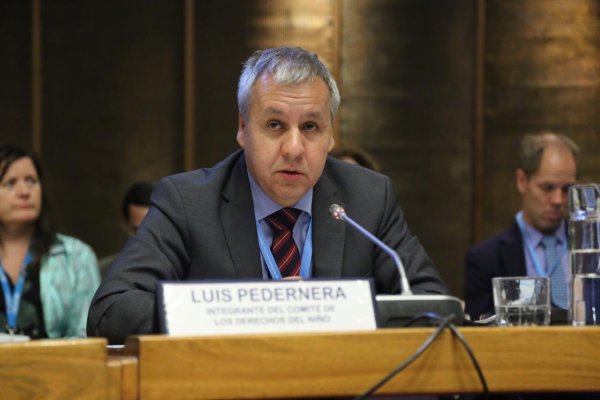
Luis Pedernera is a renowned international expert in children's rights, with an extensive career within the United Nations system. He was a member of the Committee on the Rights of the Child for two consecutive terms (2017–2025), and its Chairperson between 2019 and 2021, becoming the first Latin American and Spanish-speaking official to hold that position. During his presidency, the Committee adopted important normative instruments, including General Comment No. 24 on juvenile justice, No. 25 on children’s rights in relation to the digital environment, and the Implementation Guidelines for the Optional Protocol on the sale and sexual exploitation of children. He subsequently served as Vice-Chairperson of the Committee (2023–2025). He also chaired the Meeting of Chairpersons of UN Human Rights Treaty Bodies (2020–2021), and was the focal point for the protection of children's rights defenders under the San José Guidelines (2023–2025).
Pedernera is an advisor to UNICEF in El Salvador and other regional offices, and is a member of various international entities that defend children's rights, such as the Board of Directors of the International Bureau for Children’s Rights (Canada), the Executive Committee of Child Identity Protection (Switzerland), and the Assembly of the World Organisation Against Torture.
In addition to his institutional work, Pedernera integrates and chairs academic and scientific committees linked to world congresses on juvenile justice and children's rights, is a guest lecturer at universities in different regions, and is the author of numerous specialised articles. He has extensive experience in monitoring adolescent criminal justice systems, especially regarding the prevention of torture.
As an expert on children’s rights in Latin America, what do you consider to be the main items of progress made recently in the region’s youth justice systems?
I believe we are not seeing progress, but rather serious regressions in terms of youth justice. The common element behind these setbacks is the instrumentalisation of organised crime, drug trafficking, and gangs as a justification to dismantle the specialised nature of the system, erode guarantees and, in some cases, send adolescents directly to adult prisons, as has occurred in Peru. It is no longer merely about lowering the age of criminal responsibility, but a normative and practical hardening expressed in three main dimensions.
In the substantive dimension, we have seen the lowering of the age of criminal responsibility, as well as an increase in sanctions and the extended use of detention, including in adult prisons. Furthermore, we have also seen prosecutions based on insufficient evidence, as well as the extension of statutes of limitation. All these measures transform the youth justice system and distance it from the commitments undertaken under the Convention on the Rights of the Child.
For its part, the procedural dimension is reflected in the elimination of specialised jurisdictions and the suppression of the double instance, in addition to the use of collective hearings and via video conferencing. Added to this are overburdened legal or public defences and growing procedural opacity. All of this weakens due process and international standards of youth justice.
Finally, the authoritarian and anti-democratic politico-institutional dimension manifests in the subordination of State powers to the Executive, in regulations that limit judicial interpretation, and in the use of legislative majorities to impose punitive agendas. It also includes figures such as "faceless judges”, the expansion of police and military powers, and the normalisation of practices that gravely violate rights, such as mass detentions, enforced disappearances, and torture.
Taken together, these three dimensions reflect a structural regression that weakens youth justice, contradicts international standards, and jeopardises the comprehensive protection of adolescents.
Nonetheless, signs of hope are emerging despite these setbacks. I view favourably the responses arising from within the justice systems themselves against this authoritarian wave. In Ecuador, the Constitutional Court declared unconstitutional the law that had dismantled the specialisation in youth justice, reaffirming the validity of international standards and the need for a differentiated system for adolescents. Similarly, recently in Peru the Constitutional Court also declared unconstitutional the reform that allowed adolescents to be held in adult centres, thereby restoring a basic principle of comprehensive protection.
These rulings show that, even in contexts of normative and political hardening, institutional checks and balances exist that are capable of halting regressive measures and reaffirming commitments under the Convention on the Rights of the Child. These are encouraging signs demonstrating that constitutional justice can act as a bulwark against the expansion of authoritarian and rights-violating practices.
In some countries in the region, there is the problem of a considerable number of children being recruited by organised crime, many of whom end up facing judicial proceedings. Do you believe that the justice systems of these Latin American countries are currently offering responses adapted to the situations experienced by these children?
No. Hardening the response against adolescents recruited by organised crime means penalising the most vulnerable link in the chain, and it has proven not to resolve the underlying problem. These measures usually serve only to provide political visibility to incumbent governments, without generating sustainable solutions or respecting human rights.
It is fundamental to remember that the United Nations Security Council, in its Resolution 2427 (2018), establishes that children and adolescents affected by recruitment or use in conflict must be treated as victims and receive priority protection. The Committee on the Rights of the Child, in its General Comment No. 24, insists that adolescents linked to organised crime must be attended to through bodies that address the problem comprehensively and holistically, never through the exacerbation of military or punitive responses. Therefore, it is necessary to focus efforts on the development of protection and social reintegration programmes, access to education, health, and job opportunities, and community prevention and participation mechanisms.
There are public or political pressures in these countries seeking to respond to criminality by lowering the minimum age of criminal responsibility or prosecuting those under 18 under adult regimes, which goes against UN standards. What arguments can be used to convince these countries that these are not appropriate measures?
Comparative experience shows that, although no country has completely resolved the challenges of youth justice, there are precedents that help address complex and harsh issues through international standards.
A relevant case is Brazil, which despite facing serious problems of recruitment by organised crime and political pressure to reduce the age of criminal responsibility, has maintained since the approval of the Estatuto da Criança e do Adolescente a system with sanctions that do not exceed three years of detention. In over thirty years, this framework has not been hardened, reflecting a commitment to specialisation and socio-educational responses. The central element is basing policies on evidence: multiple studies show that if state violence is used to address violence, the result is the reproduction of criminality. Available evidence confirms that lowering the age of criminal responsibility does not decrease youth homicide rates. International examples demonstrate its failure.
As I said in the previous question, the problem of early recruitment by criminal factions must be addressed as outlined in General Comment 24 of the Committee on the Rights of the Child, which takes into account a Security Council resolution. Furthermore, there are concrete experiences in South Africa and in some US States that have opted for comprehensive responses to youth offending. These include social reintegration programmes, restorative justice, education, and community support, which have shown positive effects in reducing reoffending and building alternative life paths for adolescents in conflict with the law.
Altogether, these examples confirm the idea that international standards are not an abstract limit, but a guide for designing more effective, legitimate, and preventative policies.
Children’s access to justice is the subject of the recent General Comment No. 27 of the Committee on the Rights of the Child. This right is highly relevant in the current landscape, where so many children suffer grave violations of their fundamental rights in different parts of the world. However, why do you think it is so difficult to introduce and implement this right in most countries?
The drafting of General Comment No. 27 constitutes an awaited and necessary milestone in the development of the child rights protection system. Having participated while I was still a member of the Committee in the initial process of “draft 0”, which was later submitted to public consultation, allows me to recognise both the tensions and the hopes accompanying this moment. The Committee has been progressively establishing the issue of access to justice, and it was the Third Optional Protocol on individual communications that generated the most pressure. The possibility of children reaching the Committee directly with a complaint reflects, in many cases, the absence of adequate responses in national justice systems.
Justice systems, however, require maturation. The Latin American experience shows that children face persistent obstacles, including limited access and structural barriers, a lack of clarity and understanding of processes, practices that ridicule their participation, as well as excessive ritualism and theatricality. To this is added inaccessible language, disproportionate timeframes, and constant re-victimisation, alongside high levels of impunity. All of this results in a lack of satisfaction and redress.
The expectation is that General Comment No. 27 will become a document that guides States and strengthens those of us fighting for children's rights. From a historical perspective, it can be read as the synthesis of three moments since the Convention: the moment of initial legislative adjustments; that of implementation plans, strategies, and programmes; and the current moment, the time of justice, to guarantee real, effective, and restorative access to rights.
A subject to which you are particularly committed at present is the improvement of the youth justice system in Uruguay. What changes do you consider to be priorities?
Uruguay faces serious difficulties in aligning with international standards in two critical areas: youth justice and institutionalised children. In the field of youth justice, the country has maintained a process of increasing criminalisation of adolescents for over a decade. This path has involved the dismantling of the guarantees provided for in the Code of Childhood and Adolescence, accompanied by an increase in sentences, the elimination of safeguards, and the creation of new offences. Far from being reversed, this trend consolidates a scenario that places Uruguay in a complex position regarding international commitments on youth justice.
Regarding institutionalisation, the country is failing to move towards a model that prioritises the right of children to grow up in a family environment. On the contrary, recent years have seen an increase in the number of children in residential care. Added to this are serious structural problems in the provision of these services: poor physical conditions, episodes of ill-treatment, and even deaths of children under State custody.
Although childhood occupies a central place in political discourse, reality demonstrates a persistent gap between declarations and practices. In a country with a relatively small child population, children remain those who suffer most from the consequences of policies and the lack of structural responses. An interesting scenario is that the country has begun its review process by the Committee on the Rights of the Child, and that exercise may provide a good opportunity to advance on pending challenges and emerging issues concerning Uruguayan childhood and adolescence.